
How to Master Your Personal Efficiency by Tracking Your Daily Productivity
Tracking your daily productivity provides a clear window into how you spend your most valuable resource: time. By recording your activities, you stop guessing where your day went and start making intentional choices about your focus and energy. You will gain a profound sense of control over your schedule, identify hidden time-wasters, and cultivate habits that align with your true priorities.
This process turns vague feelings of busyness into concrete data you can use to improve your output and reclaim your leisure hours. When you commit to monitoring your actions, you transform your relationship with work and create a sustainable path toward achieving your long-term goals with far less friction and stress.
Define Your Core Objectives Before You Begin
Before you start logging every minute, you must establish what “productivity” actually means for your specific life. Many people fall into the trap of measuring volume—how many tasks they crossed off—rather than impact. If your goal is to finish a creative project, checking fifty emails might feel like progress but could actually be a distraction.
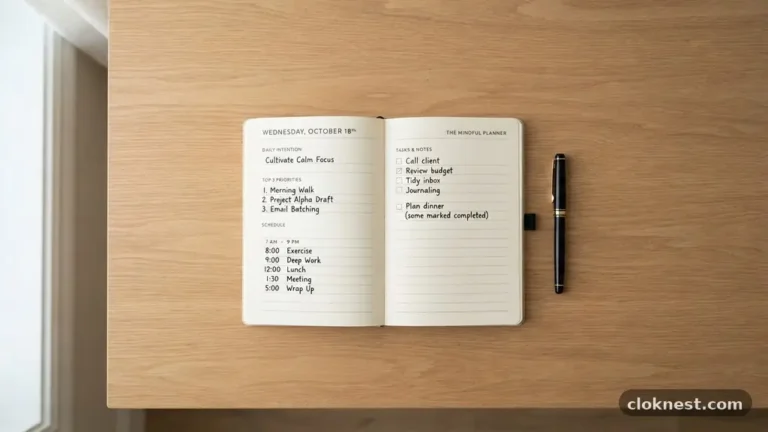
Start by identifying your “Big Three” for the day. These are the three high-impact items that, if finished, make the day a success.
Write these objectives down in a place you see constantly, like a sticky note on your monitor or a dedicated space in your notebook. When you have a clear target, tracking your daily productivity becomes a process of measuring progress toward a destination rather than just recording movement. If you skip this step, you risk spending all day checking off easy, low-value tasks while your main project sits untouched.
Avoid the mistake of setting too many goals; a list of ten items is just a wish list, not a plan. By narrowing your focus, you make it easier to see if your time allocation matches your priorities.
Select a Tracking Method That Fits Your Personality
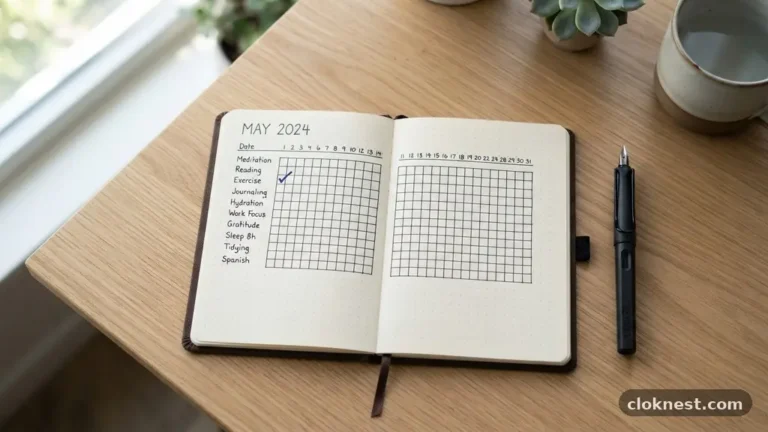
The best system is the one you actually use. Some people thrive with analog tools, finding that the physical act of writing down their tasks in a paper planner helps them stay grounded and mindful. Others prefer digital apps that offer automated reports and data visualization.
If you enjoy data and charts, a digital tool might be perfect. If you find screens distracting, a simple journal is a better choice.
Don’t overcomplicate this. You don’t need a complex project management suite to start. A simple spreadsheet or a dedicated notebook works just fine.
The danger here is “tool hopping,” where you spend more time setting up fancy software than doing the work itself. Stick to one method for at least two weeks before deciding if it works for you.
If you find yourself avoiding the tracking process because it feels like a chore, switch to a simpler format. The goal is to lower the barrier to entry so that recording your time becomes a natural part of your routine.
Record Your Activities in Real-Time
Waiting until the end of the day to reconstruct your schedule is a recipe for inaccuracy. Our brains are notoriously bad at estimating how long tasks take, and we tend to forget the small, fragmented interruptions that eat up our time.
Aim to log your activities as you finish them or in short bursts throughout the day. This habit of real-time logging keeps you honest about how long things actually take.
When you track as you go, you’ll notice the “hidden” time—the five minutes checking a notification, the ten minutes spent searching for a file, or the twenty minutes you lose to a sudden phone call. These micro-interruptions often add up to hours of lost productivity. A common mistake is to try and track every single second with extreme precision, which can lead to burnout.
Instead, track in blocks of 15 or 30 minutes. This level of granularity is usually enough to see patterns without making the process feel like a burden. Remember, you are looking for trends, not perfection.
Analyze Your Energy Patterns Alongside Time
Time is only half the equation; your energy levels are the other. You might spend two hours on a task, but if you were exhausted and unfocused, those two hours were likely inefficient. As you monitor your output, note how you felt during specific tasks.
Were you sharp and engaged, or were you dragging and struggling to focus? Most people have a “peak” time—often in the morning—where they can do their best, most challenging work.
Use this insight to shift your schedule. If you find that your energy dips every afternoon at 2:00 PM, stop trying to force yourself to do complex analysis at that time. Instead, schedule your routine administrative tasks or email clearing for those low-energy slots.
By aligning your most difficult work with your highest energy, you’ll get more done in less time. This simple adjustment often leads to a massive jump in overall efficiency. Don’t ignore these biological rhythms; they are just as important as the clock when you are looking at your daily performance.
Implement the 3-3-3 Rule for Sustainable Output
The 3-3-3 rule is a powerful framework for keeping your workload balanced. The concept is simple: spend three hours on your most important project, complete three smaller tasks, and finish three maintenance activities.
This structure prevents you from getting lost in endless to-do lists that never end. By limiting your focus to these nine items, you ensure that you are making consistent progress on what truly matters.
Maintenance tasks include things like answering emails, updating files, or responding to messages—the work that keeps the engine running but doesn’t necessarily move the needle. When you track your daily productivity using this framework, you can easily see if you are spending too much time on maintenance at the expense of your big projects. If you notice you are consistently failing to hit your three-hour project goal, you know exactly where to trim your schedule.
Avoid the mistake of letting maintenance tasks bleed into your prime project time. Protect those three hours as if they were a non-negotiable meeting.
Identify and Eliminate Environmental Distractions
Tracking your progress will inevitably reveal the culprits that break your flow. Maybe it’s the constant ping of notifications, a noisy shared workspace, or simply having too many browser tabs open.
Once you identify these distractions, you have the data you need to make changes. If you see that you lose 45 minutes every morning to social media, you can set a hard boundary for yourself.
Consider using tools like a website blocker or simply moving your phone to another room during deep work sessions. You don’t have to be a monk to be productive, but you do need to create an environment that supports your goals. If you work in an office, use visual cues like headphones to signal that you are unavailable.
When you track your daily productivity, you aren’t just logging time; you are auditing your environment. Use this information to build a fortress around your most important tasks. If you find that a specific person or activity is consistently derailing you, plan for it.
Review Your Data Weekly to Adjust Your Course
Tracking is useless if you don’t look at the data. Once a week, take twenty minutes to review your logs. Look for the patterns.
What tasks took longer than expected? Where did you lose focus?
Which days were your most productive, and what made them different? This review is the most important part of the entire process because it turns reflection into action.
Use this time to plan for the following week. If you noticed that meetings are eating up your entire Tuesday, look for ways to consolidate or delegate them. If you saw that you are consistently productive on Thursdays, try to move more of your deep work to that day.
Treat this weekly review as a meeting with yourself. It’s the time to hold yourself accountable and celebrate the wins.
Many people skip this step and lose the benefit of the tracking they did all week. Make it a non-negotiable ritual, perhaps on a Friday afternoon or a quiet Sunday morning.
Build Flexibility into Your Schedule
Life is unpredictable, and your tracking system should be able to handle that. Rigid schedules often break at the first sign of trouble, leading to frustration and abandonment of the system.
Instead of planning every minute of your day, leave “buffer blocks.” These are empty spaces in your calendar meant for the unexpected—the urgent client request, the tech issue, or just the need for a quick break.
If you don’t account for the unexpected, you’ll feel like you’re failing every time something happens. By planning for the messiness of life, you stay in control even when things go off-track. If you have a day where everything goes wrong, don’t sweat it.
Just note it down and move on. The goal of monitoring your output is to create a long-term habit, not to have a perfect record.
You can find more insights on managing your time effectively by visiting the official government resources on workforce development to see how large organizations handle scheduling and efficiency. Consistency beats perfection every single time.
Frequently Asked Questions
What is the 3-3-3 rule for managing time?
The 3-3-3 rule suggests you dedicate three hours to your most significant project, complete three smaller tasks, and finish three maintenance items each day. It provides a balanced approach to ensure you make progress on big goals while still handling daily responsibilities.
How do I know if I am tracking too much information?
You are likely over-tracking if the process feels like a chore or if you are spending more time logging activities than actually doing them. If you can’t see the “big picture” because you are buried in the details of every minute, simplify your tracking to 30-minute or 60-minute blocks.
What should I do if I miss a few days of logging?
Don’t worry about it. Perfection is not the goal. If you miss a few days, just start again immediately. Use your best estimate to fill in the gaps if you want to keep the data consistent, or simply mark those days as “untracked” and continue with your current focus.
Is it better to track on paper or with an app?
Neither is inherently better; it depends entirely on your personal style. Paper is excellent for those who need to disconnect from screens and value the tactile nature of writing. Apps are better for those who want automated statistics, reminders, and the ability to access their data from multiple devices.
Conclusion
Developing the habit of tracking your daily productivity is one of the most effective ways to align your actions with your intentions. By observing your patterns, energy levels, and common distractions, you gain the power to design a schedule that works for you rather than against you. You will find that small, consistent adjustments lead to significant improvements in how you feel and what you accomplish.
Start today by simply logging what you do for a few hours. Don’t worry about being perfect; just focus on being present and honest about how you spend your time.
As you refine your process, you will likely notice that you have more energy and clarity than you ever thought possible. Feel free to share your experiences or ask questions as you continue your journey toward a more intentional and efficient lifestyle.