
How to Plan Tomorrow Before Going to Bed
When you master the habit of planning Tomorrow Before Going to Bed, you transform your morning from a frantic scramble into a calm, intentional start. Taking just ten minutes each night to organize your thoughts and commitments prevents the cognitive load of unfinished business from disrupting your rest.
You will wake up with a clear mental map of your priorities, saving precious willpower for high-impact work rather than wasting it on decision-making fatigue. By intentionally setting your sights on the next day, you create a buffer of peace that allows you to transition into sleep without the weight of an unorganized to-do list looming over your pillow.
Clear the Mental Clutter
The primary goal of organizing your evening is to empty your brain of all lingering concerns. When you keep your to-do list in your head, you create a background loop of anxiety that interferes with falling asleep.
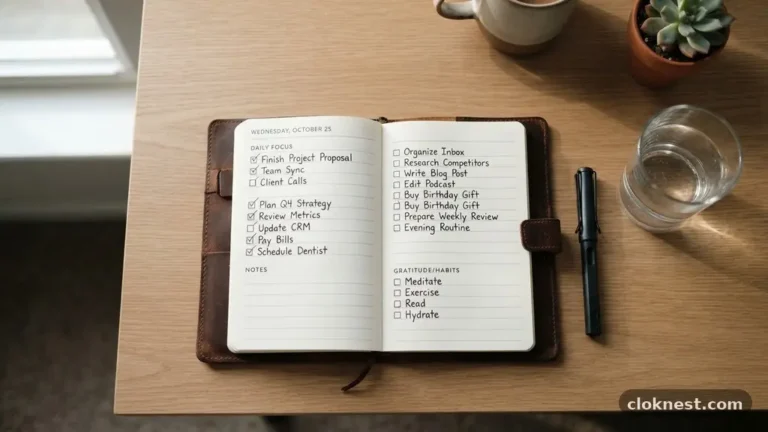
By physically writing down every task, appointment, and nagging thought, you offload that mental pressure onto paper or a digital app. This act of externalization allows your brain to stop “holding” the information, signaling that it is finally safe to power down for the night.
Think of your mind like a computer with too many browser tabs open. Each open tab consumes energy and slows down the system. When you commit to planning Tomorrow Before Going to Bed, you are essentially closing those tabs one by one.
If a task feels small enough to finish in two minutes, do it immediately to clear the space. If it requires more effort, write it down and assign it a time slot for the next day. This simple ritual prevents the “what am I forgetting?” panic that often hits as soon as you turn off the lights.
A common mistake is trying to keep your plans in a disorganized stream of consciousness. Instead, use a structured method, such as a notebook or a reliable digital task manager. If you try to hold everything in your working memory, you inevitably lose track of details, leading to missed deadlines and unnecessary stress the following morning.
Writing things down is not just about memory; it is about creating a visual representation of your reality. Once the information is on the page, you can objectively assess what is truly urgent and what can wait.
Identify Your Top Three Priorities
Once you have dumped your brain’s contents onto a list, the next step is to distill that list into your top three priorities. Most people struggle because they try to tackle ten or twelve major items in a single day.
This is a recipe for feeling overwhelmed and defeated by lunchtime. By selecting only three non-negotiable tasks, you force yourself to focus on the work that actually moves the needle on your long-term goals.
Be ruthless with your selection process. Ask yourself which of these items, if completed, would make the entire day feel successful. If you finish your top three, anything else you accomplish is just a bonus.
This approach shifts your mindset from “doing everything” to “doing what matters.” When you wake up, you won’t have to waste energy deciding where to start; you will already have your three targets clearly defined.
A frequent error is allowing “urgent but unimportant” tasks to crowd out your top priorities. Emails, slack messages, and minor administrative chores often masquerade as emergencies. When planning, categorize these as secondary items to be handled only after your three primary tasks are tackled.
If you start your morning by checking emails, you are letting others dictate your agenda. By identifying your key work the night before, you reclaim your autonomy and ensure that your most productive hours are spent on high-value activity.
Prepare Your Physical Environment
Your physical environment has a profound impact on your ability to execute your plans. If you wake up to a cluttered desk, a missing charger, or a lack of necessary documents, you lose momentum before you even begin.
Use your evening planning time to set the stage for success. This might involve laying out your clothes, organizing your workspace, or ensuring your digital files are ready for the next day’s work.
Think about the friction you encounter during your typical morning. If you find yourself hunting for your keys or struggling to find a clean shirt, these small frustrations accumulate. By removing these physical barriers the night before, you create a “path of least resistance” for your morning routine.
This is not about being a perfectionist; it is about removing the stupid, avoidable obstacles that drain your energy. When everything you need is ready, you can move directly from waking up into a flow state.
One common mistake is neglecting the digital environment. Before you head to bed, close unnecessary browser windows and organize your desktop files. If you open your computer to find a chaotic mess of icons and random documents, your brain will subconsciously feel disorganized.
Spend two minutes cleaning your digital workspace so that your screen is as clear as your intent. This simple act of preparation makes a massive difference in how you perceive your work capacity the moment you sit down.
Use the 3:2:1 Rule for Better Rest
To ensure that your planning session actually leads to better productivity, you must pair it with a wind-down routine. A highly effective framework for this is the 3:2:1 rule.
This approach suggests that you stop eating three hours before bed, stop working two hours before bed, and stop using screens one hour before bed. By adhering to this schedule, you give your body the physiological cues it needs to shift into deep, restorative sleep.
The “no work” rule is particularly important for those who struggle with overthinking. If you are still hammering away at a project right up until the moment you crawl into bed, your cortisol levels will remain elevated. That makes it nearly impossible to switch off your analytical brain.
By finishing your planning and wrapping up your work two hours early, you allow your nervous system to downshift. Your brain needs time to process the day before it can enter the regenerative state of sleep.
People often ask if they really need to cut out screens entirely an hour before sleeping. The answer is yes, because blue light suppresses melatonin, the hormone responsible for sleepiness. If you are using your phone to plan your day, you are inadvertently keeping yourself alert.
Try using a physical notepad for your final planning session. This keeps you away from the stimulating glow of a screen and helps you maintain the boundary between your productive day and your restorative night. You can find more information on healthy sleep habits through the National Sleep Foundation.
Schedule Your Time Blocks
A to-do list without a schedule is just a wish list. After you have identified your top three tasks, assign them specific blocks of time on your calendar. If you think a task will take two hours, block out those two hours.
This prevents the “planning fallacy,” where we consistently underestimate how long things actually take. By visualizing your day in blocks, you gain a realistic understanding of what you can actually accomplish.
Consider your energy levels when scheduling. If you are a morning person, put your hardest task in the first block of the day. If you struggle with afternoon slumps, schedule your administrative tasks or meetings during that time when your brain is naturally less sharp.
This alignment of task difficulty with your biological rhythm is the secret to high performance. When you plan your time, you are not just managing minutes; you are managing your energy.
A major pitfall is failing to account for transition times or unexpected interruptions. Do not pack your schedule from 8:00 AM to 5:00 PM without any breathing room. Always leave buffer zones between major tasks.
These gaps allow you to recover from a long meeting or finish a task that ran slightly over time. If you don‘t build in these cushions, a single delay will cause your entire schedule to collapse, leading to a sense of failure that follows you into the next day.
Reflect and Adjust for Tomorrow
Planning effectively isn’t just about the future; it’s about learning from the past. Before you finalize your plan for tomorrow, take a moment to look at how today went. Did you accomplish what you set out to do?
If not, why? Was the task too big, or did you get distracted by low-value activities? This brief reflection turns your daily planning into an iterative process of self-improvement.
If you find that you are consistently failing to complete your tasks, you are likely overestimating your capacity. Adjust your expectations for the next day. It is better to have a modest list that you finish consistently than an ambitious one that you constantly leave half-done.
This builds a sense of self-trust. When you know that you will do what you say you are going to do, you approach your work with much higher confidence.
Avoid the trap of being too hard on yourself during this reflection. The goal is data collection, not self-criticism. If you didn’t finish your work, don’t waste energy feeling guilty.
Simply move the incomplete items to a different day or delete them if they are no longer relevant. Every evening is a fresh start, a clean slate where you can recalibrate and approach the next day with a sharper, more realistic strategy.
Create a Consistent Ritual
The effectiveness of any habit lies in its consistency. If you only plan your day when you feel stressed, you won’t reap the long-term benefits.
You need to make this a non-negotiable part of your evening routine, just like brushing your teeth. By performing the same sequence of actions—cleaning your desk, writing your list, checking your calendar—you create a “trigger” that tells your brain it is time to shift from work mode to rest mode.
Try to perform this ritual at the same time every night. Whether it’s right after dinner or just before you head to the bedroom, consistency makes the behavior automatic. When it becomes automatic, you no longer have to exert willpower to do it.
You will find that you actually look forward to this time because it provides a sense of closure to the day. It turns the “end of work” into a definitive event rather than a slow, indefinite fade-out.
A common mistake is trying to do this while multitasking. Don’t try to plan your day while watching television or checking social media. Give this task your full, undivided attention for ten minutes.
This focused time is an investment in your productivity. When you treat your planning with respect, your brain recognizes it as a high-value activity, and you will find that your sleep quality improves because you aren’t carrying the weight of the next day into your dreams.
Address Potential Roadblocks
Sometimes, even with the best planning, life throws a wrench in the works. You might get sick, a family emergency might arise, or a sudden crisis at work might demand your full attention. When this happens, don’t abandon the practice.
Instead, adapt it. On days when things go completely off the rails, your planning session should be even shorter and more focused on “survival mode” rather than productivity.
Ask yourself what is the absolute minimum you need to do to keep things moving. This might be one single task. Even on your worst day, keeping the habit of planning ensures that you don’t lose your baseline structure.
It prevents a bad day from turning into a bad week. By keeping the ritual alive, you ensure that you can pivot back to your normal routine as soon as the crisis passes.
Another obstacle is the fear of the unknown. Sometimes we avoid planning because we are afraid of what we might find on our calendar. We might be dreading a specific meeting or a difficult conversation.
Writing it down is the best way to demystify the fear. Once you see it on paper and have a plan to tackle it, it loses its power to haunt you. Planning is the antidote to the anxiety of the unknown, turning vague fears into concrete, manageable steps.
Frequently Asked Questions
Is it better to plan on paper or digitally?
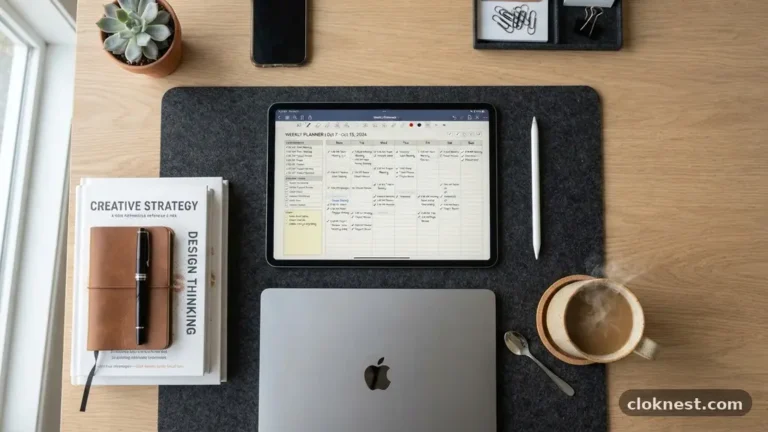
The best method is the one you actually use consistently. Many people prefer paper for the tactile experience, which helps separate work from the glow of digital screens, while others prefer digital apps for the ability to sync tasks across devices and set reminders. Experiment with both to see which helps you clear your mind most effectively.
How much time should I spend planning before bed?
Ten to fifteen minutes is usually plenty. If you find yourself spending more than twenty minutes, you are likely overthinking or trying to micromanage your schedule. Keep it simple, focus on the top three priorities, and trust your ability to execute once the morning arrives.
What if I wake up and don’t feel like doing what I planned?
It is normal to have fluctuations in motivation. If your plan feels completely impossible due to how you feel, allow yourself to adjust it, but try to stick to your main priority. Often, the resistance to starting is just a mental hurdle; once you spend five minutes on your first task, the momentum usually takes over.
What if I forget to plan one night?
Don’t worry about it; simply pick it up the next night. One missed night won’t ruin your progress. The key is to avoid letting a one-time miss turn into a permanent abandonment of the habit. Just accept it as a small bump in the road and return to your routine the following evening.
Should I plan for the entire week or just the next day?
Planning for the week is great for high-level strategy, but daily planning is essential for execution. Use Sunday evening for a “weekly review” to look at the big picture, and use your nightly routine to sharpen the focus for the specific hours ahead. This two-tier approach keeps you both strategic and tactical.
Final Thoughts
Mastering the art of planning Tomorrow Before Going to Bed is one of the most effective ways to reclaim your time and sanity. By closing the loop on your daily responsibilities, you grant yourself the mental space to truly relax during your evening hours. This transition from work to rest is not just a productivity hack; it is a fundamental act of self-care that protects your sleep and sets the stage for a more focused, intentional life.
Start tonight by putting your phone away, grabbing a notepad, and jotting down your three main priorities for the following day. You will likely be surprised by how much lighter your mind feels when you finally turn out the lights.
Commit to this practice for one week and notice the change in how you wake up. Once you experience the clarity of a pre-planned morning, you will never want to go back to the chaos of starting your day without a map.